
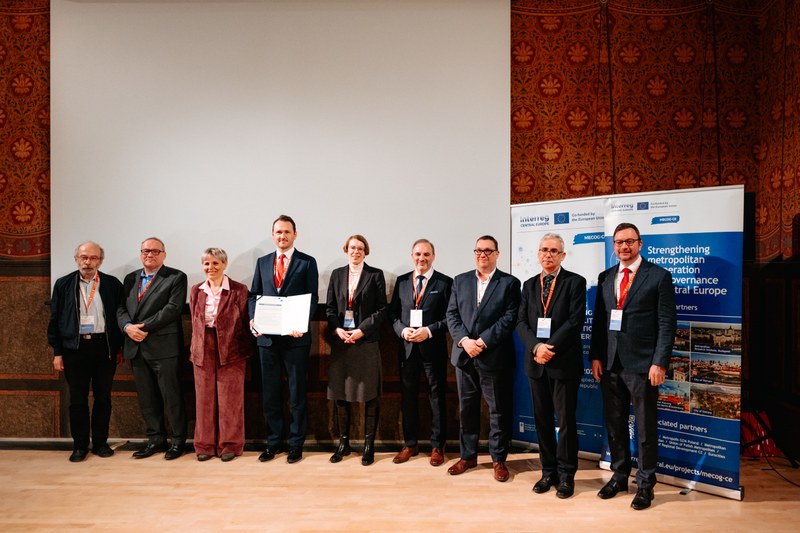
International MECOG-CE Project Concludes: Ostrava Contributed to Metropolitan Cooperation in Central Europe
The entire effort culminated in a final international conference in Brno, accompanied by the ceremonial signing of a Memorandum on continued cooperation among project partners.
The MECOG-CE project (Strengthening Metropolitan Cooperation and Governance in Central Europe) ran from April 2023 to March 2026. In both scope and focus, it represents a unique initiative addressing an important yet often overlooked aspect of spatial development in Central Europe. The project was coordinated by the City of Brno and co-funded by the European Union through the Interreg Central Europe programme.
With a total budget of €1.65 million, MECOG-CE brought together:
- six metropolitan areas: Berlin-Brandenburg, Brno, Ostrava, Stuttgart, Turin, and Warsaw
- academic and research institutions: Charles University, the University of Silesia in Katowice, and the Metropolitan Research
- Institute in Budapest
- associated partners such as the Eurocities and METREX networks
The project was structured into three phases. The initial phase mapped the current state of metropolitan cooperation in Europe. This was followed by the identification and testing of good practices to strengthen cooperation and governance. Based on the knowledge gained, new solutions were developed and are now being implemented in partner metropolitan areas. These innovative approaches address current challenges such as sustainable mobility, participatory governance, food cooperation, and more.
“Participation in the MECOG-CE project contributes to enhancing Ostrava’s prestige in Europe. I consider this topic highly relevant, as developments in Ostrava have an impact on the wider region, surrounding municipalities, and visitors who come to the city for work, culture, or sports,” said Lucie Baránková Vilamová, Deputy Mayor of Ostrava for Strategic Development and Culture.

Mayor of Ostrava Jan Dohnal described the city’s project activities: “Within the project, Ostrava focused, among other things, on a pilot action aimed at transforming the Dubina housing estate in the Ostrava-Jih district. The city established a working group composed of experts, representatives of local government, the MAPPA urban planning studio, universities, local organizations, and residents. Representatives of other cities in the Ostrava metropolitan area, such as Frýdek-Místek, Havířov, and Opava, also joined and shared their experience with similar, although smaller, localities.” The result is a socio-economic analysis of the area and a collection of insights and best practices from stakeholders, residents, and institutions, which will serve as a basis for future urban planning proposals and the preparation of a long-term transformation strategy.
In September 2024, Ostrava also hosted a two-day international meeting of project partners, where representatives of Central European metropolitan areas discussed the progress of pilot actions and shared experiences in metropolitan cooperation. Participants responded very positively to guided tours of Dolní Vítkovice, the New City Hall, and Ostrava’s city centre.

The project also enabled the creation of a platform for experts to exchange knowledge and consult on potential solutions to shared challenges. In addition to seven international meetings, partners organized a seminar at the European Parliament, bringing together experts, policymakers, and representatives of metropolitan areas from across Europe. It was clearly emphasized that metropolitan areas, which generate up to 70% of the EU’s GDP, play an irreplaceable role in strengthening the European Union’s competitiveness.
Key project outputs include comprehensive analyses of good practices and models of metropolitan governance (from both Central Europe and beyond), a Joint Metropolitan Vision and Strategy for strengthening metropolitan cooperation and governance in Central Europe, a brochure on pilot actions testing tools in practice, newly developed practical solutions for metropolitan areas, and tailored Action Plans for each partner metropolitan area.
These results and strategic tools developed over the past three years were presented at the final conference titled “Solutions for Strong Metropolitan Cooperation and Governance – Metropolitan Areas for European Cohesion and Growth,” held on 19 March 2026 at the Museum of Applied Arts in Brno. The future of metropolitan areas from both Czech and European perspectives was also discussed. A significant moment of the programme was the signing of the Memorandum of Cooperation by mayors and representatives of partner cities and metropolitan areas. On behalf of Ostrava, the memorandum was signed by Mayor Jan Dohnal, who stated that Ostrava is a key driver of regional development and actively shares innovative approaches and ideas with other partner cities, both within the region and across the Czech Republic.
The project will be formally closed at the end of March 2026; however, its outputs will continue to support metropolitan areas in addressing shared challenges and fostering cooperation between cities and their surrounding regions. A metropolitan area is a broader functional territory consisting of a core city and its surrounding municipalities. These areas are naturally interconnected through daily commuting for work, education, and services, and they share common infrastructure. In the Czech Republic, examples include the metropolitan areas of Brno, Prague, and Ostrava.